
Where do bowls come from?
Updated: Feb 4
(How they live in a tree;
how they are revealed by a woodturner.)

Woodturning transforms raw logs into beautiful, functional pieces like bowls and platters. But where exactly do these forms reside within a log? Clients who visit my workshop are often surprised to discover how bowls and platters live within the tree.
Here I will try to focus not on HOW I create standard and live edge bowls, but on how these bowls are situated within the tree.
Standard Bowls
Most people assume that bowls are oriented in the tree this way....

These would be referred to as end grain bowls since their orientation is consistent with the vertical alignment of the wood fibers. Although it is possible to turn bowls this way, creating a bowl which captures the concentric rings of the tree, it has its drawbacks. The central part of the log, called the "pith" is the most unstable part of the log and many of the cracks that form while the bowl dries tend to occur in this area of the log.

This (below) is the way that standard bowls live in the tree. At least three bowls could be made from the lower half of the log, and three more bowls (not indicated here) from the upper portion of the log.)

This (below) is how I get there. I generally saw my large logs lengthwise, avoiding the center section – which contains the pith. I save this center slab which does have some very nice wood on either side of the pith which I can use to make platters.
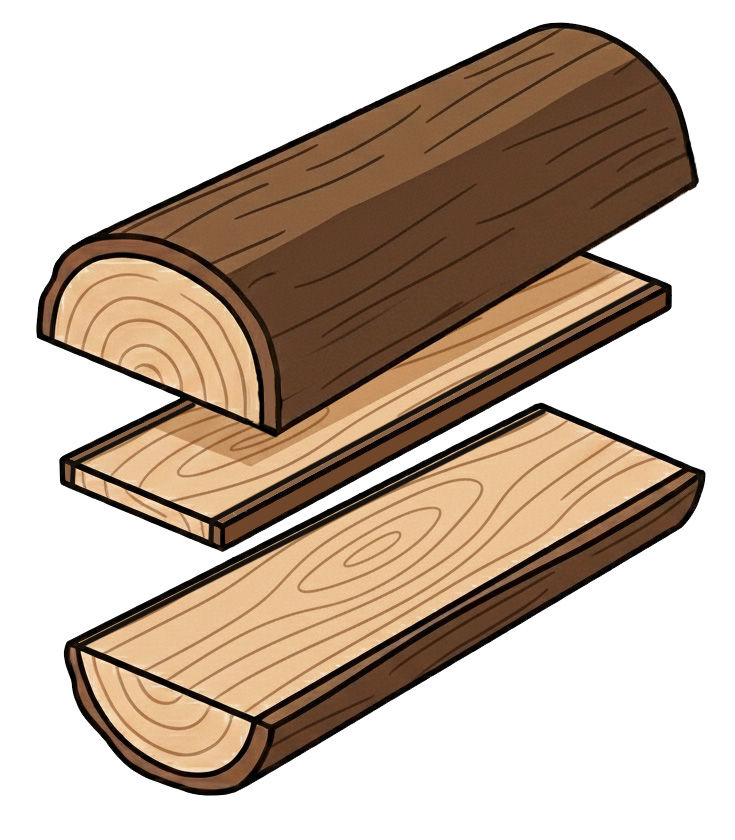
I then cut the two remaining thicker pieces across their length into shorter sections. Each of these sections (see the large Cherry piece below) will yield a bowl or a nested set of bowls depending on the size of the wood.

Live-Edge Bowls
In a Live-edge bowl the rim of the bowl reflects the curve of the outer part of the log (see images below). This is why a live edge bowl has opposing edges higher than those on its other axis. The rim may also maintain some of the tree's sapwood (usually differing in color from the heartwood) or some bark. Both of these characteristics give the bowl a rustic, organic feel.


A Pithy Postscript
Back to the pith.... The center section of the log which I set aside earlier, while it contains the troublesome pith, also contains some very nice wood on either side of it. Since the growth rings of the tree in this section are parallel to each other, this wood is very stable and not as likely to warp, crack or distort while drying. This is referred to as quarter-sawn lumber and is excellent for making smaller bowls, platters or other items.

I hope this is relatively clear. I welcome comments and questions, and please check out my other posts on my process and caring for your wood items.
Comments